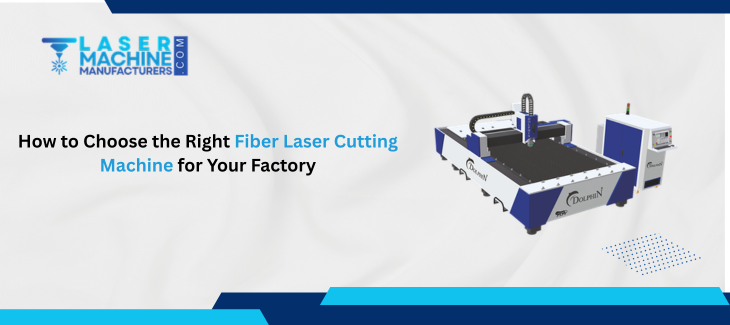
Factories today move fast. Orders come quickly, and customers expect precise work. Because of this, many factories now depend on a Fiber Laser Cutting Machine to handle metal cutting. It works faster than traditional cutting tools and gives cleaner results.
Still, buying a machine like this is not something you rush. Different factories have different needs. Some deal with thin sheets. Others cut thick metal all day. The right Fiber Laser Cutting Machine should match the kind of work your factory actually does.
Before choosing a machine, it helps to look at a few practical things.
Start With Your Production Needs
Every factory runs differently. Some factories cut small parts in large numbers. Others cut heavy metal sheets for big projects.
That is why the first step is simple. Look at your daily production.
Ask yourself a few questions:
- What type of metal do we cut most often?
- How thick are those sheets usually?
- How many hours does the machine run in a day?
- When you know these answers, choosing the right Fiber Laser Cutting Machine becomes easier.
A small workshop may not need a very powerful system. On the other hand, a large factory working in multiple shifts will definitely need a stronger machine.
Machine Power Matters
Power is one of the most important parts of a Fiber Laser Cutting Machine. Higher power allows the machine to cut thicker materials and complete jobs faster.
Common power ranges include:
- 1000W machines – good for thin sheets and light work
- 2000W machines – suitable for medium-thickness metal
- 3000W and above – ideal for heavy industrial cutting
Factories that cut thick stainless steel or aluminum usually prefer higher power. However, buying more power than needed only increases cost and electricity usage.
A balanced choice works best.
Cutting Area Should Fit Your Work
Another thing many buyers forget is the cutting area.
The cutting bed determines how big a sheet the Fiber Laser Cutting Machine can handle. If your factory works with large sheets, a small cutting table will slow down production.
Typical sizes include:
- Small tables for compact workshops
- Medium tables for regular sheet cutting
- Large tables for industrial factories
It helps to think about future expansion, too. A slightly bigger cutting area can support larger projects later.
Precision Is Important
Factories depend on accuracy. Even a small mistake in metal cutting can affect the final product.
A good Fiber Laser Cutting Machine should have clean edges without the need for finishing.
Precision helps in the following ways:
- The parts fit perfectly during assembly.
- Less material is wasted.
- Workers need less time to correct mistakes.
Machines that have stable motion systems and good control software tend to perform well in precision.
Speed Improves Productivity
Speed is another reason why many factories are adopting the use of fiber laser technology.
A Fiber Laser Cutting Machine is faster than other cutting machines. It cuts faster, and thus, more products are finished in less time.
Still, speed should not reduce quality. Machines that balance speed with precision usually give the best long-term results.
Factories that run multiple shifts often focus heavily on this factor.
Check Material Compatibility
Most factories cut different types of metals. Stainless steel, mild steel, aluminum, and brass are common examples.
Before buying a Fiber Laser Cutting Machine, confirm that the system supports the materials you use.
Some machines handle reflective metals better than others. It is always safer to ask the supplier about material capability before making a final decision.
Look at the Software and Control System
Modern machines rely heavily on software. A well-designed control system makes the Fiber Laser Cutting Machine easier to operate. Operators can quickly load designs, adjust cutting parameters, and monitor performance.
Helpful software features include:
- Simple design imported from CAD programs
- Automatic cutting path optimization
- Real-time monitoring of the cutting process
These tools save time and reduce operator mistakes.
Maintenance and Support
Machines eventually need maintenance. That is normal in any factory environment.
A reliable Fiber Laser Cutting Machine should have easy access to spare parts and technical support. When something in the machine is not working, then nothing is being produced.
Before buying, the following should be checked:
- Is the warranty period long?
- Is local service available?
- Are spares locally available?
- Is training available for the operators?
These will save a lot of trouble later on.
Energy Efficiency Matters Too
Factories also pay attention to electricity usage.
Fiber laser technology is already known for better energy efficiency compared to older cutting methods. Even then, different machines consume different levels of power.
An efficient Fiber Laser Cutting Machine reduces operating costs over time. This becomes important for factories running machines for many hours every day.
Final Thoughts
Buying a Fiber Laser Cutting Machine is a big decision for any factory. The right machine could significantly boost the speed of production, minimize wastage, and ensure precision in the final results.
It would be more beneficial to consider other important factors rather than the price of the machine. These factors would include the power of the machine, the cutting area, and the materials it can handle.
Once the factors match the production needs, the Fiber Laser Cutting Machine would then become a valuable asset to the factory.
For factories looking to improve cutting speed, accuracy, and overall productivity, investing in a Fiber Laser Cutting Machine can be a smart long-term solution.
FAQs
- Is the Fiber Laser Cutting Machine suitable for small factories?
The answer is yes, as there are small and compact machines available.
- What kinds of metals can be cut?
The machine can cut stainless steel, mild steel, aluminum, and other similar materials.
- Does it need highly skilled operators?
Not really, as the machine is quite easy to operate.
- How long does the machine last?
The fiber laser system, when well-maintained, could last for many years.
- Is maintenance expensive?
Not usually. Fiber laser systems generally need less maintenance than older cutting machines.
For more updates and insights about modern laser cutting technology and industrial machines, you can also follow us on Facebook.