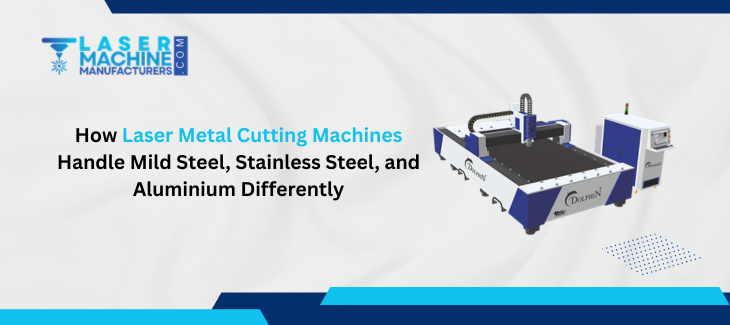
If you have ever watched a laser cut through a sheet of metal, it looks almost the same regardless of what the material is. A bright, focused beam, a thin kerf, clean edges coming out the other side. Simple enough from the outside.
The reality inside that cut zone is very different depending on which material is sitting on the cutting bed. Laser metal cutting machines do not treat mild steel, stainless steel, and aluminium the same way at all. Each material absorbs laser energy differently, reacts to assist gas differently, and demands different parameter settings to produce a quality cut.
Understanding these differences helps operators get better results and helps engineers write better cutting specifications.
How Laser Metal Cutting Machines Actually Remove Material
Before getting into the material differences, it helps to understand what is actually happening during a laser cut.
The laser beam focuses down to a very small spot on the material surface. That concentrated energy heats the material rapidly to either its melting point or its vaporisation point, depending on the process being used. An assist gas blows through the cut zone simultaneously, removing the molten or oxidised material from the kerf and keeping the cut path clear.
The three variables that change most between materials are:
- How efficiently the material absorbs the laser wavelength being used
- How the material responds to the assist gas chemistry
- How quickly the material conducts heat away from the cut zone
These three factors drive almost every parameter difference between cutting mild steel, stainless steel, and aluminium on laser metal cutting machines.
Cutting Mild Steel -Oxygen Does the Heavy Work
Mild steel is genuinely the most straightforward material for laser metal cutting machines to process. The carbon content in mild steel absorbs laser energy well, and the material responds predictably to oxygen-assist gas.
When cutting mild steel with oxygen, an exothermic oxidation reaction happens inside the kerf. The steel burns in the oxygen stream and releases additional heat beyond what the laser alone provides. This combustion energy significantly boosts cutting speed and allows laser metal cutting machines to cut through thicker mild steel sections than pure laser energy alone could manage.
Key characteristics when cutting mild steel:
- Oxygen assist gas produces fast cutting speeds and good edge quality on thicker sections
- The oxidation reaction creates a thin iron oxide layer on the cut edge
- Cut edge colour tends toward blue or straw depending on heat input
- Nitrogen assist gas can be used instead for oxide-free edges when downstream welding or coating requires a clean surface
- Dross formation on the underside increases significantly if cutting speed or focus position drifts from the optimised setting
Mild steel rewards consistent parameter settings. Once a cutting program is dialled in for a specific thickness and grade, laser metal cutting machines hold that quality reliably across a full production run.
Cutting Stainless Steel -Nitrogen Keeps the Surface Clean
Stainless steel changes the approach considerably. The chromium content in stainless steel forms a passive oxide layer on any cut edge exposed to oxygen during cutting. This discolours the edge, reduces corrosion resistance in the heat affected zone, and creates problems for applications where the finished surface matters.
For this reason, most laser metal cutting machines process stainless steel using high pressure nitrogen as the assist gas rather than oxygen.
Nitrogen does not react chemically with the material. It acts purely as a mechanical blowing agent, pushing molten metal out of the kerf without contributing any additional heat energy. This produces bright, oxide-free cut edges that retain the corrosion resistance of the parent material.
Key characteristics when cutting stainless steel:
- High pressure nitrogen assist gas is the standard approach for quality edge finishes
- Cutting speeds run lower than mild steel at equivalent thickness because the nitrogen provides no combustion assistance
- Higher laser power settings are needed compared to mild steel for the same plate thickness
- Dross attachment on the cut edge underside is more common on stainless steel and requires careful parameter optimisation to minimise
- Reflective surface finishes on polished stainless grades can cause beam back-reflection issues on some older laser metal cutting machines without adequate protection systems
Stainless steel also conducts heat less efficiently than mild steel. Heat builds up more readily in the cut zone, which demands careful management of cutting speed and power to avoid burning or edge discolouration even when using nitrogen.
Cutting Aluminium -Reflectivity Is the Main Challenge
Aluminium presents a different set of challenges for laser metal cutting machines compared to ferrous materials. The biggest issue is reflectivity.
Aluminium reflects a large proportion of the laser energy that hits its surface rather than absorbing it. CO2 laser wavelengths are absorbed reasonably well by aluminium but fibre laser wavelengths, which dominate modern laser metal cutting machines, are reflected at a much higher rate by aluminium surfaces. This reflectivity creates two problems:
- Less energy actually enters the material, reducing cutting efficiency
- Reflected energy travelling back toward the laser source can damage optical components if the machine does not have adequate back-reflection protection
Modern fibre laser metal cutting machines address this through back-reflection protection systems built into the cutting head. However, the reflectivity still means that aluminium requires higher power settings relative to its thickness compared to mild steel.
Key characteristics when cutting aluminium:
- Nitrogen or compressed air assist gas produces the cleanest cut edges
- Aluminium melts at a lower temperature than steel, but its high thermal conductivity pulls heat away from the cut zone rapidly
- High cutting speeds combined with high power give better results than slow, heavy cutting passes
- Burr formation on the cut edge underside is a common challenge on thicker aluminium sections
- Alloy composition affects cut quality significantly, with high silicon content alloys cutting more cleanly than some high magnesium content grades
Surface condition also matters more with aluminium. Oxide layers, protective films, and surface contamination all affect how consistently laser metal cutting machines perform on aluminium sheet.
Explore advanced laser metal cutting machines built for precise cutting on steel, stainless steel, and aluminium sheets.
Parameter Differences Across the Three Materials
To summarise the practical differences operators manage when switching between materials on laser metal cutting machines:
- Assist gas switches from oxygen on mild steel to nitrogen on stainless steel and aluminium
- Cutting speed decreases moving from mild steel to stainless steel to aluminium at equivalent thickness and power
- Focus position requires adjustment between materials because each material has a different optimal focal depth relative to the surface
- Nozzle standoff distance and nozzle diameter change between oxygen cutting on mild steel and high pressure nitrogen cutting on stainless and aluminium
- Power settings increase moving from mild steel to aluminium for equivalent plate thickness
FAQs
Q1. Can the same laser metal cutting machine cut all three materials?
Yes, most modern fibre laser metal cutting machines handle mild steel, stainless steel, and aluminium. Parameters and assist gas need to be changed between materials.
Q2. Why does aluminium need higher power than mild steel of the same thickness?
Aluminium reflects more laser energy and conducts heat away from the cut zone faster, so more input power is needed to maintain the cut.
Q3. Can oxygen assist gas be used on stainless steel?
Technically, yes, but it oxidises the cut edge, destroys the passive layer, and reduces corrosion resistance. Nitrogen is the correct choice for stainless steel.
Q4. What causes dross on laser cut edges?
Dross forms when molten material is not fully expelled from the kerf by the assist gas. Wrong cutting speed, incorrect gas pressure, or poor focus position are the usual causes.
Q5. Does plate thickness affect which material is hardest to cut?
Yes. On thin sections, all three materials cut reasonably well. On thicker sections, aluminium becomes progressively more difficult due to reflectivity and thermal conductivity combined.
Follow us on Facebook for more simple guides and insights on laser cutting machines and industrial technology.